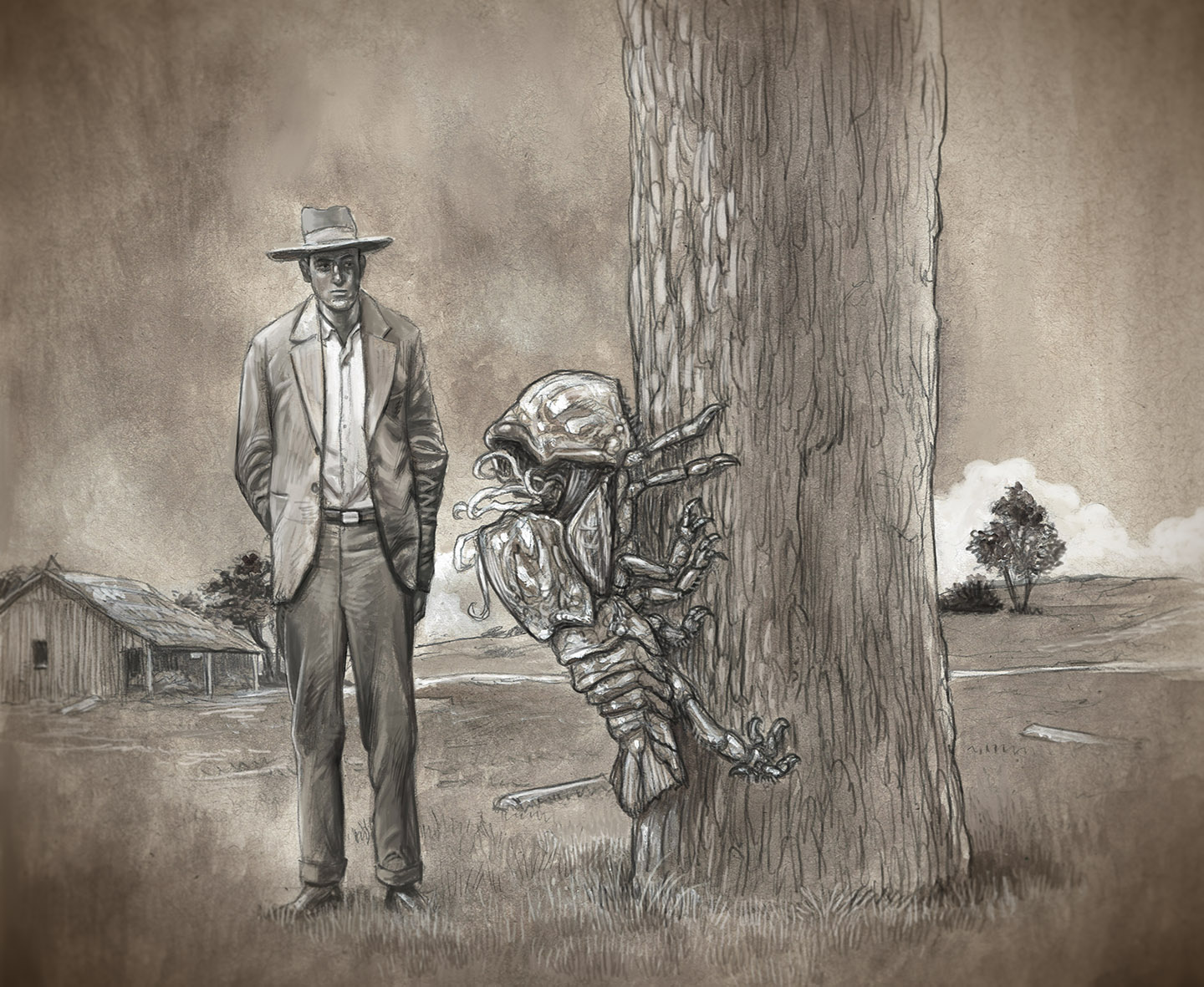
Kurt Komoda     agony@optonline.net
Follow me on Instagram! https://www.instagram.com/kurt_komoda/

Saturday, May 21, 2016

H.P. Lovecraft's Night-gaunt: The Tickling Terror

   "Suddenly, without a warning sound in the dark, Carter felt his curved scimitar drawn stealthily out of his belt by some unseen hand. Then he heard it clatter down over the rocks below. And between him and the Milky Way he thought he saw a very terrible outline of something noxiously thin and horned and tailed and bat-winged. Other things, too, had begun to blot out patches of stars west of him, as if a flock of vague entities were flapping thickly and silently out of that inaccessible cave in the face of the precipice. Then a sort of cold rubbery arm seized his neck and something else seized his feet, and he was lifted inconsiderately up and swung about in space. Another minute and the stars were gone, and Carter knew that the night-gaunts had got him."
                                                        - H.P. Lovecraft, The Dream Quest of Unknown Kadath, 1927


    H.P. Lovecraft wrote of the night-gaunts in his poem "Night-Gaunts" and in the story "The Dream Quest of Unknown Kadath." He certainly had a vision of what they were and how they behaved because, as a child, he was tormented by them in his nightmares- which I'll talk about a bit later. They were later expanded upon in the writings of Brian Lumley, who hinted that they may have mouths with which to suckle Yibb-Tstll's black breasts.

   The alternate title to this post could have been "Why I Hate Wings On the Backs of Humanoid Anatomy." For almost a quarter century I have struggled to come up with a feasible way that wings on a humanoid (while still retaining normal arms) could work and, for now, have concluded, like so many others, that it just doesn't- not with our bone structure and musculature, anyway. To carry the weight of the human body, the wings would have to cover an extremely large area, with a wing span of something like 25-30 feet. Now, the muscles needed to move such limbs would be immense, requiring additional bone area on the scapula and sternum- and these muscles and bones couldn't interfere with the existing arms. It just becomes ridiculous. Wings just growing out of shoulder blades always bothered me, even in the most beautiful depictions of angel or demon. For the purposes of fantasy, it really is best to ignore it and just plop those wings on there. What I am going to do, then, is take my very limited knowledge of physics and physiology and try my best to come up with a solution for a humanoid with wings while at the same time freely ignoring some of the complications.

   If we can change the anatomical structure of the organism we're dealing with, we're given some anatomical leeway. You see, we're not dealing with a human, or even an earthly lifeform. In fact, we're not even dealing with something that is absolutely confined to the physics of this universe. The night-gaunt is a denizen of the H.P. Lovecraft's Dreamlands, and while it is a "real" place- just one separate from ours- it is fantastical, and while I won't be as lazy as to just say this or that happens or exists "because magic," I'm pretty sure it is exempt from at least some of the laws of physics. I mean, cats can jump to the moon- the Dreamlands moon with forests and oily seas on the dark side of it. The Dreamlands is a constantly changing world, formed by the dreams of the people of Earth. Other planets and realms have their own Dreamlands.

   So, in no way would the night-gaunts that I draw "work." Lovecraft described them as "noxiously thin," so I wanted no musculature. The night-gaunts are black and rubbery, with a skin texture akin to a whale's. I picture them like a skeleton or demonic armature covered in oily latex, but with a bit of weathering here and there. The only loose flesh they have is the membrane of their bat-like wings. Lovecraft, again with the bat-like wings. It leaves room for artistic liberty, but this time I decided to stick with almost exactly a bat wing. Problem is, a real bat's wings are comprised of its two arms and the membrane goes all the way down to the ankles and then across to the tail. Night-gaunts have to have those two arms in addition to those wings.
    
night-gaunt crawling with wings folded
Night-gaunt with its wings folded. In this design, the wing membrane only extends down to about the hip, something I later changed by extending it to the ankle.

   Those Damned Wings: The problem with just attaching wings so that they just stick out the back of the shoulder blades is that, because there is an existing set of shoulders in the way, they would lack the clearance for the down sweep in the flapping motion. Now, if you watch this slow motion footage of a bat in flight from the Smithsonian Channel, you can see that while the wings don't down sweep to steeply, they still can't be blocked by the previously existing shoulders, lats, and rib cage, so the attachment point (where the humerus attaches to the scapula) has to be wide enough to accommodate this range of motion. It's basically like wearing a "wing pack" on one's back.   Notice that even the legs and the tail/tail membrane are involved in the flapping motion in the video below.


   Speaking of flapping, I've watched bats flying around in my parents' backyard on many a summer night. We used to throw pebbles into the air and watch them chase them for a bit. One time, my brother and I even tried bits of bologna, and I know at least one of them caught the piece- don't know if it ate it or not. Anyway, a bat's flapping sound, though quiet, is still audible. Lovecraft made a point of saying that the night-gaunts were completely silent, even in flight. Now, owls have special serrated feathers along the back edge of their wings to allow for near-silent flight, and that just doesn't work for membranous wings. Basically, I'm just going to attribute this to being a supernatural Dreamlands...thing.

Night-gaunt skeleton
Night-gaunt skeleton showing "stacked" scapula. I'm not saying that this would work, but this is kind of what it would have to look like if we have have the ol'wings-popping-out-of-the-back type of demon.


Night-gaunt wings
The forward shoulders (the "normal" shoulders, if you will) on these sketches are too broad. The shoulders of the wings would have to extend out a bit further to allow a full range of motion.

   Assuming that the night-gaunt bone structure was light enough to allow for winged flight, it's still unlikely that they could carry the weight of a struggling human, but in the Dreamlands - and we might as well say in all of fiction- it is possible. I am confident we can all think of an instance where a winged  man-thing has carried something about its own size aloft, so we're just going to have to let that go (even though I will not let the wings sticking out of shoulder blades thing go!). In Dream Quest, the night-gaunts were able to lift the toad-like moon beasts into the air. Now, the story never describes the size of the moon beasts, but I imagine them to be these heavy, blubbery things. It takes several night-gaunts to haul even one up into the air, and not always successfully: "Sometimes a group of the black flutterers would drop a toadlike prisoner from aloft by mistake, and the manner in which the victim would burst was highly offensive to the sight and smell." I love that.

Two night-gaunts carrying a moon beast.
Two night-gaunts carrying a moon beast. A rather small moon beast. Probably should have drawn it larger.
  
 For some reason, once the night-gaunts are no longer these fearsome shadow entities and take on the role of loyal soldier and transportation, they fly in pairs to carry our hero Randolph Carter and his ghoul allies through the sky. I'm assuming that this was for some sort of comfort, but I cannot figure out how this would work. It's really hard, if not impossible, for a pair of winged things to carry a singular object- not talking about something spread out like a tarp or a ribbon- without their wings interfering with each other. Take a look at this illustration from The Wizard of Oz, drawn by W.W. Denslow:


   Now, it looks wonderful as an illustration, but there's just no way those flying monkeys could flap their wings without hitting each other or Dorothy. Still, I bet that what we see in the drawing is exactly what Lovecraft was thinking.

Attempts to figure out how exactly night-gaunts carry someone.


   Now, in the drawings above, we can see that it still would probably be best for just one night-gaunt to carry one man or ghoul, though, I doubt that there would be a comfortable way to do this. In the first drawing, it's like the man is being held in baby-swing position, with the hands grasping the thighs from below and the back being supported by the forearms. The second drawing shows a tandem carry- with one night-gaunt behind or below the other. This...I suppose could work, though I don't know how efficient it is and it doesn't look very comfortable the way I've drawn it. In the third drawing, the night-gaunts have these tiny Final Fantasty Moogle wings, so they can fly side by side and not bump into each other. Okay, I haven't solved this at all and I'm not going to. Let's move on.

night-gaunt back view, with a view of the wing membrane.
I imagine that the wing membrane wouldn't be so saggy looking as this, but I was using a hairless bat as reference and loved how the membrane looked.

The Basic Shape: Lovecraft dreamed of the night-gaunts. Rather, he was tormented by them in dreadful nightmares, as described in a letter to friend: "When I was 6 or 7 I used to be tormented constantly with a peculiar type of recurrent nightmare in which a monstrous race of entities (called by me 'night-gaunts'—I don't know where I got hold of the name) used to snatch me up by the stomach...and carry me off though infinite leagues of black air over the towers of dead and horrible cities...The "night-gaunts" were black, lean, rubbery things with bared, barbed tails, bat-wings and no faces at all. Undoubtedly I derived the image from the jumbled memory of DorĂ© drawings (largely the illustrations to 'Paradise Lost') which fascinated me in waking hours."
   
   And then "...They had no voices & their only form of real torture was their habit of tickling my stomach...before snatching me up & swooping away with me. […] They seemed to come in flocks of 25 or 50, & would sometimes fling me one to the other." -I cannot find a copy of this letter or a complete transcript of it- only portions of it here and there. There are numerous books dedicated to the letters of Lovecraft to various friends.

   I think that the silent, black, night-gaunts in Lovecraft's dreams were like winged nightmare shadows come to life. Of the tickling sensation, I can say that I have personally felt something like this- sort of an electrifying paralyzation that occurs in dreams- probably akin to dream paralysis (where certain motor functions have shut down during sleep but your mind is semi aware). It has happened to me while being attacked by some nondescript entity (a shadow or shape). I wonder if it's the same thing that Lovecraft was talking about.

What a night-gaunt is made of.
The elements of my night-gaunt design. The bat wing is from www.uksafari.com. The devil's purse, the black beetle (possibly blaps gigas), and the black wasp paralyzing a spider to be used as her future nursery (possibly Anoplius nigerrimus) are my own.
   
   When drawing the night-gaunt, I drew inspiration from a few things. Obviously, bats. The bat wing and the texture of the membrane was very important. Devil's purses, which I find on the beaches on the Jersey shore, have the perfect texture (when soaked) and these long, curly hooks on them, which made me think of claws adapted for tickling (I guess another design would be something that looked like a Koosh ball for a talon). I like the rubbery black texture of the beetle and I've always felt that the night-gaunts would have a wasp-like appearance with their elongated limbs, not to mention their behavior.

A Trip Down Night-gaunt Memory Lane: Now, I've been drawing night-gaunts for years (and not real well, mind you!). So, let me show you some of my early designs from way back there in the closet full of sketchbooks.

Early night-gaunt sketches

   July, 1992: My first drawings of the night-gaunt were pretty typical. I think those horns would be considered outward pointing, so that's wrong. You can see by the bottom sketch that I'm already troubled with the wings on the back concept.

Early night-gaunt sketches.

   July, 1992: At this point, the head is just this ovoid shape. I'm starting to elongate the limbs, but the forms are still too thick, especially the tail. 

Early night-gaunt sketches.

   First studies of bat wings and how they might apply to the night-gaunt. You can see that I basically just took the bat on the left and stuck it on the night-gaunt on the right. At this point, I even had a small set of pseudo legs extending from the hip so that the wing membrane could attach there.


Early night-gaunt sketches.

   January, 1993: I thought it might be interesting to add a bit of form to the head, but these camel-like designs are just funny looking. The two-thumbed design on the right is stolen directly- and badly- from Wayne Barlowe's Overlord design from Barlowe's Guide to Extra Terrestrials- one of my favorite books from my childhood.

A crouched night-gaunt.


    1994: By this point, my night-gaunt designs began to take on more insectoid qualities. Wings have a barbed or serrated edge and the horns are still outward pointing. 

night-gaunts with strange arm configurations.

   1999: Introduction of the "x-faced" night-gaunt. Horns became larger and ridged. Was playing with the idea that the non-wing arms would be these arthropod limbs extending from either side of the chest which, when folded, would fit into the cavity under the sternum. I dunno.

Night-gaunt derivations.

   1999: Okay, I have no real explanation for the one on the left, with its huge crustacean arm and muscular legs. The thing on the left side of the right page is just a doodle, but I kind of still like the night-gaunt on the right, although I could do without the massive hips/pelvis.

night-gaunt sketches

   2000: A really clumsy handling of the wing limbs on the left, with both pages looking more towards pterosaur anatomy, Still sticking with the "x-face" design.

bad night-gaunt sketches

   2000: Still pursuing the pterosaur wing design. The drawing on the right was supposed to be night-gaunts communicating through gesture, but I abandoned it on the grounds that it sucked.

night-gaunt sketches

   2006: Doodles of the night-gaunt with the x-face becoming less pronounced. Also, studies for Baku, a Yokai from Japanese mythology. Yep, all those years later and the wing design was still no closer.

The Head: I don't have a real clear opinion of how the head should look. It seems like every time I draw one, the head is a bit different.

night-gaunt heads

   Various night-gaunt head designs, some with the hint of features. The one in the center that's just pencil line- not shaded with wash- was a design that occurred where there would be this mass of wrinkles that could form expressions. I thought this might be something, since they spoke entirely in gesture, but then realized that it would imply a definite feature on a featureless face, so I abandoned it. It was a silly idea. The lowermost one with the black wash is this "X-shaped" night-gaunt face that I was using for years. Also, you can see that I haven't settled on a horn shape, yet.

   The interesting thing about drawing the head and neck of the night-gaunt, and one that I was constantly forgetting, is that this is a creature with no features, which meant that it had no nasal passages, no need for any musculature on the face, no mandible, no throat, and -supposedly- they were mindless. I don't think that necessarily means that they have no brains, but it is interesting to think that they are these just dream constructs, without any need for such things.

night-gaunt skulls
Night-gaunt skulls.

   I began to think of what their skulls might look like. I'm guessing that they would be these solid masses of bone, but it's also interesting to think of a skull being nightmare twisted. Like if you took a human skull and smeared it flat like it was made of clay. The remnants of features and divisions in the bone might still be visible, but maybe don't transfer to the skin that encases it.

   Looking at my old drawings, the description of the night-gaunts being faceless immediately made me think of this smooth surface where a face would be. As time went by, I began to add hints of features or even features that could contradict a face. In the end, I think a blankness, like a phantom's face in stark shadow, is more appropriate. Right now- and I say this because my opinion may change in an hour- I even want to avoid the hints of a brow or cheekbones, as I have done in the previous drawings. Maybe it all goes back to the x-face. I still like that one. 

night-gaunt head shapes


   The night-gaunt head is just one of these things that keeps changing in my mind, and I'm not sure why. With the inward curving horns: again, there's a lot of leeway, but we can take note that no special attention was paid to them, so we know that they probably weren't immense or elaborate. Right now, I'm partial to the second one in the top row in the sketch above.

crawling night-gaunt

The Hands: As the instruments of the night-gaunt's torturous tickling, at the last minute when starting the drawings for this post, I decided to make their fingertips- in fact the tips of all their extremities- these long wiry things, like the hooked ends of the Devil's Purses I find on the beach. I had considered- and with no justification from the source material- that they can extend and retract these hooks at will, but really only because when I look at them I think that they must be terribly bothersome when not tickling something.

night-gaunt hands- although, they were actually described as paws
Hands of a night-gaunt. Tips retracted.
   No matter what, long fingers and toes lend to the look of the night-gaunt, so I like them to be almost cartoonishly elongated.

Further Thoughts: I was going to do a whole section about the night-gaunts form of communication through gesture, but I felt that it was pretty self-explanatory and I wanted to finish this within the week. I do wonder what they would talk about, unless it's just directions of how to get to this or that, similar to how bees communicate to other bees the location of a flower (by wiggling their butts).

   Even though the night-gaunts are mindless, there must be some continued order throughout the species, as they have certain enemies and allies  and seem to know where things are in the world. I'm not going to go into night-gaunt reproduction because I have no idea and I don't think that Lovecraft  ever even thought about that.

   I find it curious that Lovecraft was tormented by the very thought of these winged beasts, but that in The Dream Quest of Unknown Kadath they are almost instantly made to be tame with the use of a secret password, which I bet Lovecraft himself had wished he had possessed when he was 6 years old. 

bowing night-gaunt


Tuesday, May 10, 2016

The Mi-Go, the Official Lovecraftian Monster of Vermont


   What follows are my attempts to depict H.P. Lovecraft's Mi-Go, the Fungi From Yuggoth (probably Pluto) based on his descriptions in "The Whisperer in the Darkness." I make no claims as to their accuracy, but this was just a fun creative project to do in a week where not a lot of freelance work is coming in. Okay, let's dive in.

   The Mi-Go are described as 5' pinkish, vaguely humanoid, crustaceans that were more vegetable than animal, having a fungoid structure- despite the presence of a chlorophyll-like substance. The had several pairs of limbs and great bat-like wings that extending from the middle of their backs.Their heads were a mass of ringed pyramids covered with short antennae, There were a few more descriptions throughout the story, but we'll get into those later.

- Oh, I'm going to be going into spoilers for "The Whisperer in the Darkness, " so if you have not read it- do this now: The Whisperer in the Darkness

The body of a dead Mi-Go seen in flood waters of the Passumpsic River, Vermont. 
  
 Right off the bat, the whole "fungus thing" trips me up a bit. I suppose it could mean that even their carapaces were made of some sort of fleshy, spongy substance, but for some reason I've always jumped to the conclusion that Lovecraft was referring to their heads and internals- or just their basic molecular structure was fungoid (there are some rather hard and tough fungi out there). I think my design may be a bit too lobster-like, but as I tried to design and re-design my Mi-Go, I kept coming back to it. Well, both fungi and crustaceans have chitin in common. It forms the cell walls of fungi and crustacean exoskeletons.

   The second stumbling block was the whole vaguely humanoid outline. Now, Lovecraft wrote of this in such a way that it gives a bit of leeway. Walking upright on two hind legs with an ovoid head on top may be all he was suggesting. I did know that I wanted to give them larger hind legs, while the rest of the limbs would serve as arms.

Vaguely humanoid? ehhhhhhh....kind of. Vaguely vague. 

   Now, the vaguely humanoid outline comes into play late in the story- like real late, as in the very last sentence- when it is revealed that the strangely stiff and be-robed seated figure of Henry Akeley has been a Mi-Go in disguise, wearing what our narrator,  Albert N. Wilmarth, prays to be just perfect facsimiles of Akeley's face and hands (it's more or less suggested that they are, in fact, Akeley's actual face and hands). So, apparently, all it takes is the mask of a face wrapped around the head and neck with a long yellow scarf, a dressing gown, a pair of human hand gloves, bandages wrapped about the feet, and a comfy chair in a dimly lit room to disguise a Mi-Go as a human being.

"Don’t bother that fresh, shiny cylinder joined to the two testing instruments—the one with my name on it." Okay, H.P. I'm sure that won't come back at some point.

   This complicated things, because all of my early designs were way too bulky to pull off this sort of ruse. I hadn't read the story for about 25 years and had somehow forgotten the bit about them fitting into the shape of a human. I figure the robe in a seated position could have been very bulky with odd shapes here and there and still pass without suspicion in a poorly lit room.

Here is a drawing I did earlier this year, before re-reading the story. There are multiple problems with it. First, the antennae on the head are too long. It lacks hind legs to walk on. Although it does have hands, I wanted more of the Mi-Go's limbs to be practical for an intelligent race capable of hyper advanced surgical procedures.

Early sketch done for this blog, when I was still in the early stages of trying to work out the wings. All of my early sketches (from last week) have this kind of bulky structure. As they go on, they become more streamlined.
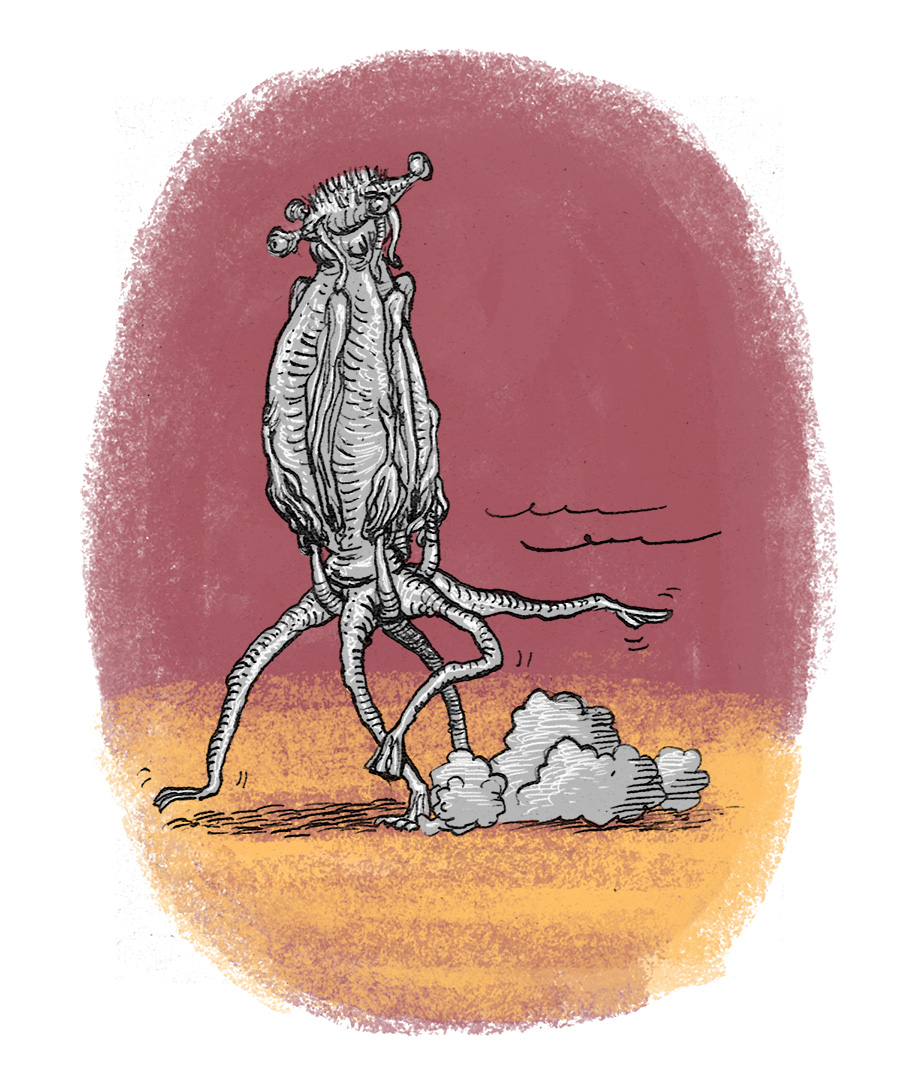
The Wings: Wings always give me trouble. The Old Ones' wings gave me a lot of trouble. The wings of the next blog post's subject, the Night Gaunts (or any humanoid with wings apparently sticking out of their scapula), gave me trouble. The wings of the Mi-Go gave me trouble because you have these bat-like fleshy membranous body parts somehow attached to chitinous body parts. Yeah, they're beings from outside the known universe, but Lovecraft mentioned the parallel evolution with our crustaceans, and you can't just have membranous wing attaching to a chitinous carapace. I mean, you could, but it wouldn't look right.


   The first sketches were just trying to figure out how to attach a bat-like wing to an exoskeleton. I was still pretty sure that the final result would definitely not just be a bat wing.


   I decided to try and base my wing design on an insect wing, but one that still looked "bat-like." The wings of larger beetles, like the Hercules Beetle, have this appearance. Toward the bottom of the page, you can see that I started to blend it with a bat wing, complete with a membrane that attached and stretched along the body, as opposed to tapering to a single point connection, like an insect's wing.


    The final design- or, the one I've settled on for now- is combination bat-insect wing that somehow fold up real nice and tight like a real bat wing. Now, real bat wings have a huge wing surface because the membrane basically goes from the bat's shoulder down to its ankles,and then webbing on the tail forms more of a wing surface. Here, the wing surface only goes from the shoulder to about where the hip would be.It wouldn't work at all unless the Mi-Go's body structure was incredibly light -which it may very well be. Well, in the story it does say that the wings were meant to traverse the ether of interstellar space and were not very well suited for flight on Earth. The only one seen flying leapt from the top of a hill, and besides...their very atomic make up- their electron vibrations, it says- are wholly different from ours. There's a little leeway in the physics.


The Limbs: Of this, I am certain: that I really do not know how the limbs of actual crustacea work or fit together and that anyone with a passing expertise on the subject will recoil in disgust at what I've done, BUT...I will again resort to the fact that we're talking about outer beings from outside the known universe, wholly comprised of a different type of matter. I have, however tried my best to adhere to Lovecraft's "parallel evolution" and made these  things try to make as much sense as is possible within my limited knowledge. 


      As you can see in the drawing and quotes from the source material above, dated April 27, 2016, the first thing I tried to tackle was the be-nippered claw of the hind leg, which left the footprints of ambiguous direction. The description says that there was a central pad and then pairs of nippers extending from that. I originally drew 3 pairs of claws, but later brought it down to 2 pairs, for no particular reason. I figure that the claws would lay flat when walking, but all four on each foot could be used like a 4-clawed hand. The multiple claws would become the basis for the other limbs, moving up the torso.


    So, starting with the hindmost pair of legs, we have 4 claws or nippers, as Lovecraft refers to them. The next 3 pairs are the primary hands. I figure that an exceedingly intelligent race that has been on earth for hundreds of millions of years (they came from space and waged war against the Old Ones at one time) capable of  interstellar navigation and travel and miraculous surgery would need something more than claws. These hands have 3 segmented digits, one in the position as a thumb as opposed to being evenly distributed like a tripod. They would have softer, padded surfaces on the palms and undersides of the digits for gripping. The last two pairs of limbs (the topmost) are your basic pincered crab-like limbs.


The Technology: 


   Above is a drawing of, well, the latest in Yuggothian kitchen appliances, apparently. You all know very well that "Akeley" had Wilmarth plug wires from 3 devices into one of the metallic cylinders they use to store the live brains of other beings. One device gave the brain in the cylinder sight, the other a voice, and the third hearing....I think.

    I didn't give the devices described in the story much attention, because I didn't really know where to go with them. It bothers me that such an advanced race, using metals not of this earth, would use dials, wires, plugs, and vacuum tubes. I *suppose* they could have, I dunno, just been efficient by using local hardware they had access to, but....would they really use that technology with beings from other planets during their space travels? This is obviously just a case of Lovecraft not being that keen of a futurist. I mean, with the right two-way brainwave translating software, one smart phone is probably more advanced than all 3 of the devices mentioned in the story.

The Head: For some reason, most artists tend to draw the head looking like a big exposed brain. The story describes the head as "a sort of convoluted ellipsoid, covered with multitudes of very short antennae" and "a lot of pyramided fleshy rings or knots of thick, ropy stuff covered with feelers." Okay, so here we go:


   Now, I don't know the dimensions of the pyramided ring structures or their distribution about the head, but I did want to evoke a fungus-like appearance. It didn't say that the numerous short antennae extended from the tips of the pyramid structures, but it just seemed like the thing to do. I mean, why would antennae be recessed? I took liberties with the mouth area and the modified palps that look like mantis shrimp chelipeds. I haven't drawn the mouth in detail, but I figure that they're similar to crab mouths, although capable of speech. 

    The Mi-Go communicated through 3 methods: telepathy, buzzing noises which could imitate speech in any language, and by changing the colors of its head. I figure that their heads have chromatophores like squid and cuttlefish and can communicate with elaborate color displays (Video of squids communicating through flashing color changes). Most useful in the vacuum of space, although...telepathy would seem to trump any other type of communication, but what do I know?

Molting: As a kind of arthropod, it seems likely that the Mi-Go would have to shed their skin to grow. No mention is ever made of this in any of the stories, so this is just creative speculation. Now, again, they're outer world beings with a fungoid structure, so anything goes, but I like to think that they go through many instars before their final molt, when they finally grow their wings.

Molting Mi-Go

   Above, we see a Mi-Go undergoing its final molt, emerging from in between the first and second segments of the cephalothorax carapace, similar to how a lobster molts. Up to this point, the wings were underdeveloped wing buds, but upon shedding its skin, fluid is pumped into these buds and they grow into full wings.


   Okay, the above is something no one would ever see, but not because the Mi-Go are a secretive species on our plant, but because the exuvia, the shed skin, would disintegrate hours later just as the dead bodies of the Mi-Go do. Being not of our part of the universe, their matter breaks down soon after death. Also, while I made a weak attempt to make it look like a vintage photo, the matter of which Mi-Go are made cannot be photographed (at least by cameras in 1928, when the story takes place). I was just messing around with a silly idea, since I had such a childhood fascination with cicadas.

Himilayan Mi-Go, aka Yeti

Abominable Snowmen and Other Species: Henry Akeley tells Wilmarth that the Vermont species of Mi-Go are one of the few that still have wings. The word Mi-Go comes from the Tibetan Migou- "wild man"- another name for the Yeti or Abominable Snowmen. Supposedly the legends of the Yeti or Migou come from the sightings of the Himalayan species of Mi-Go. Having been on Earth for hundreds of millions of years, they've had plenty of time to evolve into separate species or, I suppose, to surgically or genetically alter themselves to better suit their environments.

   I originally drew the Himalayan Mi-Go covered in long wispy fur, being inspired by the Yeti crab (Kiwa hirsuta) until I realized that 1) the Mi-Go are perfectly fine traversing the cold vastness of space, and 2) that the Yeti crab's fur isn't used for warmth, but possibly for chemosythesis, using the filamentous bacteria to detoxify the water around the deep sea hydrothermal vents where it lives.Still, I wanted there to be some sort of white fur. Enough to possibly have evoked the legends of the Yeti. I also wanted them to be wingless and a bit sturdier; built less lobster-like and more like a coconut crab (Birgus latro). 

***************

    Well, that's all I have for now, I hope to have another post next week. Bye! Follow me on Instagram: https://www.instagram.com/kurt_komoda/


Mi-Go Tessellation from 2022.


Monday, April 25, 2016

A New Look At The Old Ones

Elder Thing tessellation

   H.P. Lovecraft's monsters, whether they be immense gods from the deepest fathoms of primordial space or something scurrying within the walls, have filled, perhaps even cursed, our imaginations ever since his first works were published. Lovecraft had a gift for implanting clear images of his lumbering, skittering, gibbering, creeping, lurking, flapping horrors within the minds of his readers with just the vaguest of descriptions. I believe that he described the Byakhee by listing just what it wasn't entirely.

   There was, however, one time where Lovecraft described one of his creatures in precise detail. I am, of course, referring to the Old Ones, also called the Elder Ones or Elder Things. In At the Mountains of Madness, Lovecraft describes the findings of the Miskatonic Expedition to Antarctica, in 1930-31, where are found the remains of the Old Ones and the great city they once inhabited some 600 million years ago. We have the benefit of reading the descriptions of the partially and fully intact specimens extracted from a limestone cave as reported by Lake, a biologist. What we get is an end-to-end verbal depiction, complete with measurements, an autopsy, and theories of function. Later observations are written to us by Dyer, a geologist and the narrator of the report.

   Yet, I'm surprised that so many artists, given such a thorough brief, get so many things wrong. Now, I'm not saying that mine are anywhere near perfect- oh, hell no! Why, in the drawing above, the head is too big, the body too short, and the extended wing too small- but we'll get into the dimensions in just a bit. Across the board, every artist seems to miss that the Old One has 5 wings, one in each furrow between the 5 ridges of its torso. The number of wings is mentioned more than once. It's really odd that it's overlooked.

   The first specimen found was thought to be the preserved remains of possibly some sort of vegetable or perhaps a species of marine radiata. The specimen was heavily damaged, missing  the bulbous necks on either end of the five-staved barrel-shaped torso (which, I guess looks pretty much like a star fruit, but not as sharp-edged), the head and legs, and the crinoid-like arms. The wings were mostly damaged, but still intact:
star fruit
Star fruit

Old One/Elder Thing corpse torso

   The wing is too small, again- but I'll fix that later. Okay, let's get down to the dimensions. The drawing below represents the later, intact specimens and has every measurement mentioned in the text:

Elder Thing measurements by Kurt Komoda

   The overall height is 8', with the dark grey torso measuring 6' end to end. At each end, a lighter grey bulbous neck, with the top one having gills, which are not described in any detail. Atop this, there is a puffy star-shaped head of yellowish hue, 2' point to point (which is odd, since a 5-pointed star doesn't really have directly opposing points) and covered with 3" of wiry prismatic cilia. At the end of each point, are 3" yellowish stalks that end with a bulbous protrusion that, when folded back, reveals a glassy, red-irised eyeball. Protruding from the inner points of the star-shaped head are reddish tubes that end in sac-like swellings that, when squeezed, open up into a bell shape with a 2" diameter and are filled with sharp white teeth. In the center of the head on the top is a slit-like mouth.

   Around the equator of the 6' star fruit-like torso on the outer ridges of the 5 staves are the crinoid-like arms. They start with a 6" stalk, 3" in diameter, which then divides into 5 arms 8" long, which then each subdivide into 5 tentacles for a total arm length of 3'.

   In the 5 furrows of the torso are folded the 5 dark-grey membranous wings, which open into fan-like structures with a total extended reach of 7'. The wings are supported tubular or glandular structures of a lighter grey color with minute orifices at the wing tips. The formation of these tubules is not described. More on all of this in a bit.

  At the bottom, below the bulbous light-grey "neck" is a star-shaped structure, similar to the head, but of a greenish color and with muscular legs extending from the points: 4' long, 7" diameter at the base, tapering to 2.5"and terminating in a triangular five-veined webbed foot 8" long and 6" wide at the "toes." Protruding from the inner points of the greenish star are 2' reddish tubes, 2" diameter at the base and tapering to 1" at the end, used for excretion.

   A total of 14 Old One bodies were found, with 6 badly damaged and 8 in pristine condition. These intact specimens were apparently in a sort of Old One rigor mortis, with the eyes and mouths folded tightly down and the legs and excretory tubes folded tightly up:

Elder thing body folded up

   Now, let's take a closer look at the Old One's star-shaped head. I wasn't really sure how to depict the eyes, except that they were described as glassy red globes. They might have been pupil-less, but I always draw them with this small, black pupil- and I think mostly because I am so inspired by Wayne Barlowe's beautiful depiction . Though, he paints it with only two wings visible and the arms of the wrong proportions, it's still my favorite because he's just such an incredible and inspiring artist.

Elder thing eyes
Elder thing eyes

elder thing head
Elder thing head with dimensions

   Up until the drawing of the Old One's head with the white gouache highlights, above, I always drew the prismatic wiry cilia only growing in patch in the center, surrounding the slit mouth, as in the un-highlighted drawing below it, but I'm not really sure why. Lovecraft describes it as covering the head. For this drawing, I figured that maybe the cilia would be dispersed in kind of the same way that some starfish are covered with short spines or prominent nodules.

   I used to draw the 5 reddish, bell-shaped mouths on much shorter stalks, but after seeing Lovecraft's own sketch of the Old One, along with his notes, which appear to be scribbled on an unfolded envelope, I now draw them at about equal length and size to the eye stalks.  Just to the right side of the head, in between an eyestalk and a mouth, he has a line pointing to the extended tube of the mouth and the notation "1 ft"- a measurement that does not appear in the story.

Lovecraft's notes for At the Mountains of Madness
   Moving down to the neck we have the gills. Unfortunately, Lovecraft does not go into any description of these except by saying that there are "gill-like suggestions." I only assume that there are 5, or 5 sets of gills. Here, I've drawn a neck that's supposed to have 5 sets of 3 gills each, but there's really no basis for this choice. 

Elder thing gills

   Of the arms, Lovecraft wrote that they were crinoid-like, which means that they may actually be more feathery and delicate than those I have drawn here. I imagine that they are extremely strong and can manipulate objects with surgical precision. Most everyone gets the proportions wrong on the arms which, repeated, are that they have a 6" stem which branches into 5 8" segments, which then each branch into 5 1' 10" arms, for a total of 25 arms. 125 arms all around.

elder thing working rubik's cubes

   Now, the wings. The wings are a problem. Lovecraft describes them as "combs or wings that fold up and spread out like fans."  He does not say where they are attached, but I've always drawn them attached around the middle of the 5-staved torso.

Elder thing wing and reproduction
5-veined wing design with spore cases along the serrated edge. Inset is a photo of cryptogam spore cases.
   I've also always drawn them with five tubular veins- but "combs" would suggest more than just 5. That, and in Lake's report, he does not say that there are 5 veins in the wings, yet he seems to make note of the number 5 in so many other features. It seems like if there were just 5, he would have said so. As I continue to draw them for this blog, I've been going from the 5-veined wing to a wing that looks more like the pectoral fins of a Sea Robin.

Photo by Ned DeLoach, marinelifeblog.com  
 No matter where on the torso they are attached, I also have a problem trying to figure out how they fold up. They can't just open and close like a paper fan and still have a 7' wing spread- unless they attach near the top of the torso, below the gilled bulbous neck and then extend down to where the lower bulbous neck ends (see figure A, below). 
  
   Lovecraft's drawing and notes (above) confuse me because the sides of the torso have this jagged edge, like a pinecone or something. I think those are the wings folded up. On the left side, there is an arrow which points out to the note: (circled) "Fan-like expansible to 7 foot spread." And then: "veined  ?????-membraned comb-????. At tips- ends of veins are spore cases." So, those could be the serrated edges of the comb-like wings somehow sticking out of the furrows, but....I don't see how those would unfold....unless the tubular veins extend each time, but I doubt it.

   The way I have it, the wings spread open like a paper fan, but then when closing, are bent back into the body, folding once so that they fit into the furrows in between the staves  (figure B, below). This would still allow for the more comb-like appearance alluded to, with more glandular tubing (figure C, below).

elder thing wing variations

   I like the idea of the Old Ones flying, using all 5 wings, perhaps even alternating pairs or triplets of wings. I imagine that they can fly horizontally, but can also turn their wings 90 degrees for vertical flight. Millions of years ago, they lost their interstellar flight ability through a loss of some sort of technology or chemical formulae, but also through an evolutionary change in structure. Lake noted that they seemed most adapted to a marine environment.

elder thing flying with all 5 wings
Old One in flight, using all 5 wings.

 The legs: "Tough, muscular arms four feet long and tapering from seven inches diameter at base to about two and five-tenths at point. To each point is attached small end of a greenish five-veined membranous triangle eight inches long and six wide at farther end." Well, right off the bat, Lake describes them as "arms." Probably more appropriate, since I imagine them being used as such when not being used for locomotion. I suppose that the triangular flippers could be as powerful and dextrous as a hand. I drew some quick illustrations to show how the Old Ones might use these appendages.

elder thing running
Quadrupedal Gallop

elder thing standing tall
"Bipedal." By bringing pairs of legs together, the Old One could stand upright and imitate a biped, using the fifth leg as a tail. No, I don't know why this would ever happen.
elder thing crawling
One One crawling with the help of its crinoid-like arms.
elder thing walking with footprints
"5-Legged Spider Walk." Probably the main method of getting around on land.

elder thing climbing
Old One climbing.
elder thing sprinting
All out run, using all five legs and occasionally one or more pairs of wings.

elder thing swimming
Inspired by cephalopod movement, here we see an Old One using all five of its wings, as well as its legs and arms, to propel itself quickly through the water.

elder thing swimming
An Old One under water, skimming along the sea floor, using the legs as flippers and one pair of undulating wings, like a ray or skate. 
   In the story, the Old Ones are found to have dug vertical pits, in which they buried their dead, covering them with a 5-pointed star-shaped mound. Now, I first thought that maybe they had dug these graves by using their legs and just burrowing down. Problem is, this was in Antarctica, and they'd surely be digging through 8 or 9 feet of permafrost. Perhaps, the five veins of the triangular feet could be pinched together to form a sharp tool and then expanded and used like a spade or shovel. In conjunction with the crinoid arms, which could also be clustered together to form various tool-like shapes, these could be used to carry soil up and out as they burrow down. More simply, they could have used the tools of the expedition team. After waking up, the surviving Old Ones appeared to have made use of a gasoline stove, which they later took with them, and Lake's anatomical instruments to dissect one man and one dog on the same table where he had performed dissections on what he thought were cadavers. So, the Old Ones had quickly learned to make use of human tools and devices, as well as apparently leafing through many of the illustrated texts available.


elder thing dissecting a human
An Old One dissecting a human.

   All of this is just a creative exercise and an excuse to draw a monster that I got a little carried away with. It was supposed to be this one day thing, with just a few drawings, but then I kept seeing gaps. I still see gaps (didn't get into the mouths or five anuses, which seem strangely and humorously excessive), but I have to put a lid on it. I'm already in over my head and I've probably gotten a dozen things wrong. I've been neglecting this blog for some time, so I intend to return to it soon with another creative exploration of some other beasty.

   BYE!   - Kurt Komoda

A drawing of an Old One with incorrect proportions. Maybe it's a juvenile Old One (a Young Old).

an industrious elder thing
An older drawing, from 2012, of a rather industrious Old One. With their advanced 5-lobed brains, I figure that they can multi-task pretty well.