Kurt Komoda     agony@optonline.net
Follow me on Instagram! https://www.instagram.com/kurt_komoda/
Showing posts with label monster. Show all posts

Monday, July 4, 2016

Ghastly Ghouly : H.P. Lovecraft's Ghouls and Ghasts


Lovecraftian Ghast and Ghoul

 My original plan was to handle the ghast, gug, and ghoul all in one post, since they all converge at one point in Lovecraft's Dream Quest of Unknown Kadath, but as I was writing and drawing I found that I was going on and on about the gug, leaving no room for the other two. A better pairing might have been the ghast and the gug, since they appeared to be enemies of old, with the ghouls trying to avoid them both- but, here we are. One commonality between the ghast and the ghoul (aside from both of them starting with "gh") is that they're both basically slumped anthropomorphic naked things with claws and sharp teeth. Even though the story makes them quite distinct from one another, I had them both confused for a long time. The first time I tried drawing them was ten years ago, in 2006:

My first ghoul drawing from 2006. I think I gave it hooves only because I had it confused with the ghast, although the ghouls were described as having half hooved feet.
My first ghast study from 2006.
  Of course, now I find it quite easy to distinguish the two species and have some difficulty in comprehending how I had previously muddled them together. The most distinguishing feature of the ghoul is its canine-like head. In Arabic folklore, the ghūl is a type of jinni, a spawn of Iblis (the Devil). First mentioned in One Thousand and One Nights, it is associated with graveyards and the consumption of human flesh, but it is also known as a desert-dwelling shape shifter that can assume the appearance of any animal, but especially the hyena. The hyena has been linked with the ghoul partly because of its tendency to dig up graves to devour human flesh but also because of the trickster nature attached to it, no doubt helped by the hyena's ability to create sounds that sound like human laughter or crying. I believe that Lovecraft may have drawn from this particular bit of folklore. That the ghouls communicate through a series of glibbers and meeps (as opposed to the ghasts, who communicate in the coughing gutterals  of their Pnathic language) further supports this.

More traditional ghouls in a sketch for an illustration I did for The Burning Wheel RPG.

An article containing an interesting bit about the ghoul and its relation to the hyena in Arabic sources HERE.

Interesting history of the ghoul HERE.


   The ghouls are described as having rubbery skin that ranges from white to green. Initially, I was drawing them completely hairless, but in later drawings (meaning this week) I've begun to add sparse hairs in certain spots to give them a grungier look. I used a lot of photos of hairless dogs as reference. They have bloodshot eyes, great fangs, pointed ears, flat noses, and scaled claws (like a bird of prey or a reptile, I suppose). Of great help was a drawing of a ghoul by Lovecraft, himself- something that he apparently drew for Pickman's Model. You'll notice the jutting lower jaw, underbite fangs, and that short tail- none of which are mentioned at all in the texts. Edit 28JUL22- I have a new blog post that examines this drawing closer right here--> Of Ghouls and Graveyards: Lovecraft in Providence

H.P. Lovecraft's drawing of a ghoul.
Lovecraft's drawing of a ghoul.

Lovecraftian ghoul in profile.

      Of particular interest is the fact that the ghouls are transformed humans, but by what process, I know not. In Pickman's Model, ghouls are seen depicted in a painting training an abducted human child to eat as they do, turning the child into one of them. Another painting depicts a matured changeling- a ghoul baby left in place of a stolen human baby- sitting amongst its Puritan family, curiously displaying features similar to Pickman, himself, who later appears as a ghoul in The Dream Quest of Unknown Kadath.  I'm not sure if that meant to infer that he was already a ghoul (that he was a changeling) or if it was just something he desired. Incidentally, we never hear of female ghouls- though, I can assume that they exist.


The one drawing on the ground with the stick was supposed to be Pickman, but I think I should have had him be just slightly more human, as the story suggested that he was recognizable as Pickman and that he hadn't completely turned.
     Now, the ghast is something I was sure I'd find in folklore, but apparently, this is a case where the word existed- Middle English: gast "afraid" 1350-1400- and then the monster came later. "Ghast" is an obsolete term for "to frighten,"and then, of course, ghastly, aghast, and beghast. As far as I can tell, we have Lovecraft using it for his beasties and then....Minecraft. Someone please correct me if I missed the actual origin

A Minecraft Ghast

   Of course, Lovecraft's ghasts came first and aren't giant floating cubes with tentacles that make monstrous baby sounds and shoot fireballs- which really makes me wonder why Mojang, the developers of Minecraft, decided to call that thing a Ghast in the first place. Lovecraft's ghasts are humanoid, about the size of a small horse, and possess long legs with which they hop about like kangaroos. Their coloration is never mentioned, but their bodies are described as filthy and scabrous. For some reason, I always had the impression that they were a sickly grey color, but there isn't anything to justify this. We can be reasonably sure that they weren't any garish color and didn't have any obvious patterning, like stripes or spots, i.e. if they were bright purple with yellow feet and green spots, Lovecraft would most surely have pointed this out.


   As for the ghast's head, they have a face that "is so curiously human despite the absence of a nose, a forehead, and other important particulars." When I eliminate the nose and the forehead, a lot of my attempts tend to look too reptilian, which I don't want.

lovecraftian ghast head designs
Lovecraftian ghast head designs.

This one looks too much like some sort of snake-man and the legs are too short.

   I kept getting this reptilian snake-man look when drawing the head, but then my brother sent me this picture of a man with severe facial disfigurement from World War I:\


   No disrespect for the man in the photo, but something about it was on the level of being disturbing that I wanted for the ghast. The photo might be squashed down vertically a bit, but the compressed shape may have been part of why it reminded me of the ghast. The horrible eyes, definite absence of a nose, receding forehead, the protruding teeth, and the way that the flesh of the neck just stretches onto the small lower jaw: all seem to me to be crucial elements for the ghast.

   From the beginning, I've always drawn the ghast with big, round luminous eyes. Not sure if that's right, but I seem to be stuck on them. Originally, I drew them with very flat faces- just eyes over a gaping mouth, but then there's this bit in Dream Quest where it describes them as biting the gug sentry with their muzzles. So, I've been trying to draw them with the mouth protruding from the face a bit. The fact that they're venomous makes me give them sharp reptilian teeth. Even though I don't always depict them, I figure they must have nostrils, for they are supposed to possess an acute sense of smell. Ears: not sure, so I tend to draw them very small or not at all. I give them this slightly bulbous cranium, and strangely, that was mostly because when I was drawing them, they were looking a lot like a demonic version of E.T., from the Spielberg movie.

This particular ghast head drawing possesses mammalian teeth. Even though I tend towards rows of sharp reptilian teeth, perhaps it's more disturbing if they look more human. This one also lacks nostrils, which they probably should have.

   The good thing about ghasts- and, in fact, all the Lovecraft monsters I've drawn, is that they're a species, so they're allowed to look different from one another. There could be a variety of head shapes within the limitations of the description. The image below shows rather silly drawings, but it shows how I was playing around with the ghast's face.


   The ghast's legs are pretty straightforward, though I keep drawing them slightly differently- and I keep forgetting to make them long enough. They're basically just hairless kangaroo legs, complete with the sharp hooves- especially that long center hoof-claw. 

The ghast's hopping movement. I'm not sure how such movement would differ without the kangaroo's long tail, which I'm pretty sure it uses for stability and as a counterweight when leaning and hopping forward. Of course, they could have tails- since the ghouls have tails and Lovecraft never mentioned them.

Ghast standing flat and up on its toes.
Ghast standing flat on its feet and up on its toes.

   As far as culture, the ghasts appear to have none. They're described as primitive beasts who hunt the gugs in packs- and the gugs, in return, hunt the ghasts in the darkness of the vaults of Zin. The ghasts communicate through coughing gutterals, but this by no means assures that they have a working language. Female ghasts? No idea. I don't suppose that ghasts just sprout out of the ground or reproduce by budding, so I suppose that they're should be some form of sexual reproduction. Well, in Lovecraft literature, unless we're talking about a witch, no females are mentioned. Asenath Waite Derby, from The Thing on the Doorstep doesn't count, because she was a female body possessed by a male throughout the story. Oops. Spoilers.

A sketch for an ink and water color drawing I was preparing for this blog, but I was surprised and disappointed to find that the ink I was using (Higgins Eternal black ink) was not waterproof.

 Okay, that's about it for this post. Oh, one more thing. Here's a little size comparison chart I drew the other day of all the monsters I've done so far in this series:


Not sure what's next. I may do a non-Lovecraftian beastie or two, since there are a bunch I already have a load of drawings for. If you're interested in purchasing any of the drawings you see in this blog, just contact me at agony@optonline.net. Not all drawings are available, and some of them aren't even actual drawings or have been reworked in Photoshop. Until next time, bye-bye!

Alice in the Dreamlands


Thursday, June 2, 2016

Gug Ugly


   The full title was actually going to be Gug Ugly: Let's Try to Not Draw a Face Vagina, but I didn't want that showing up on all the links to this page. Then again, maybe it would have done wonders for my exposure. Anyway, let's get going here.

   We return to H.P. Lovecraft's The Dream Quest of Unknown Kadath, but this time we move underground, to the eternal twilight of the subterranean Dreamlands. A week ago, I thought that this post would be Gugs, Ghouls, and Ghasts (oh my), as I was going to cover those three. As I started sketching, however, I realized that all three were giving me problems and were eating up sketchbook pages, so I'll hold off on the ghasts and ghouls until next week. Now, I had already done some drawings of what I thought the ghasts and ghouls looked like years ago, but I had somehow never drawn a gug. Lovecraft's description is mostly in a single paragraph:

    "It was a paw, fully two feet and a half across, and equipped with formidable talons. After it came another paw, and after that a great black-furred arm to which both of the paws were attached by short forearms. Then two pink eyes shone, and the head of the awakened gug sentry, large as a barrel, wobbled into view. The eyes jutted two inches from each side, shaded by bony protuberances overgrown with coarse hairs. But the head was chiefly terrible because of the mouth. That mouth had great yellow fangs and ran from the top to the bottom of the head, opening vertically instead of horizontally."


   Further descriptions include that they stood 20' tall and were voiceless and communicated through expression, though the muffled snortings of sleeping gugs are heard in the very next paragraph.It's interesting to note that the gugs are a fallen race, previously worshippers of the so-called Other Gods and Nyarlathotep, banished to the underworld by earth's gods for some abomination they committed. The gugs are somewhat intelligent, at least, having built a great city of round cyclopean towers that disappear into the grey subterranean sky. They also have some sense of reverence, for they have erected a great forest of monolithic monuments to mark the graves of their dead. I have to consider all this when drawing them. I can't just have them be this slathering, lumbering monster, as I have seen so many times before. Now, I'm not saying that they wore full suits of clothing or played golf, but there must be a sense of culture.

Initial sketches, trying to figure out the mouth and arm structures, and of course, just how cultured the average gug is.

   At the very worst, I figured, they have, since their banishment to the inner earth, devolved over aeons to be like our own Stone Age ancestors, for they have a kingdom and a great wall and the aforementioned city of looming towers.


   Okay, I'm not going to go as far as the drawing above as far as costume, but it makes sense that the gugs would have bags or packs for carrying things, maybe belts, definitely tools and weapons. I imagine them wearing talismans and maybe other forms of jewelry. Note that in the above drawing that I was trying out digitigrade legs, like those of a quadruped, and that the gugs still lacked any visible ears. This gug is also carrying some sort of staff made from a bioluminescent plant, but this may just be ornamental and is not intended to be used as a torch in the dark. The fact that they live in near darkness and that they their pink eyes glow just tells me that they can see just fine. Maybe that's wrong, but having luminescent eyes just hollars night vision to me.


   Still, just because they can see in the dark doesn't mean that they wouldn't mind a little extra light here and there, so I'm fine drawing them holding sources of light. I haven't drawn the gug city or any gug dwellings, but I imagine that they could be lit or decorated with torches or luminescent objects.

The Gug Head: Yes, it's going to look like vagina dentata with eyes, so let's just get that out of the way. When I first started drawing the mouth, I had this idea that it didn't make much sense that the eyes would be attached to the two jaws, as they opened and closed like a bear trap. It seems like the gug would be blind to what's in front of it as it opened its mouth unless the eyes were very close to the open maw or they stuck out to the sides sufficiently. Lovecraft, however stated that they only jutted out two inches from the barrel-like head.


   Now, when you have a creature 20' tall, and I figure the head is about 4-5' tall, 2" is a very small distance for those eyes to jut out. In other depictions of the gug- in fact, in mine, too- the eyes stick out way more than 2". In the detail above, I've drawn the eyes pretty small, but I figure that the bony ridge surrounding the eye juts out 2" from the sides of the head, but the eyes could be part of the face and be much larger.

   Still, at this point, I was concerned about the eyes moving with the jaws as they opened wide, but mostly because I was thinking that the eyes would be back, halfway between the front and the back of the head, like where human ears are. I came up with some designs that had the jaws separate from a skull that held them, like a split egg shape inside a cup.


   In the sketches above, you can see that I had three basic concepts for the jaws. The first (A) was the split egg shape being cradled by a surrounding skull. I only did this to keep the eyes stationary, but it just didn't seem right. The second (B) had the jaws hinged onto the outside of a skull. Notice how far back the eyes are in that early version. The third (C) was a clam shell or bear trap design, with the entire head opening and closing. This is certainly horrific, but I couldn't figure out how that would fit on a neck or how the throat would work.  In the lower left, you can see that I did a version where I rotated the mouth at a 45 degree angle...because I was thinking that the gug wouldn't be able to hold food in a bear trap like mouth that was completely vertical- this gets solved in a moment. What I ended up doing (D) was a variation on B, but by moving the eyes forward, the jaws could open and close and the gug could still see what it was biting into.


   I made it so that the gug's jaw hinged on the top and bottom of its skull and didn't occupy the entire head. Solving the food spillage problem was simple: add a tongue. The gug's tongue attaches behind and below the lowest and furthest back teeth of both jaws and is massive, able to fill the entire mouth. It is triangular in shape, being flat on top, and is able push and maneuver food past itself, along both palettes, to the throat. Even with the tongue managing food, the gug still needs to throw its head back to properly engulf food.

   Also here is the first drawing of the gug ear and the head looks kind of like a twisted bat's. It is noted that the gug's have excellent hearing, and living in an eternal twilight and in the vaults, that makes sense. I settled on something like the pointed ear of a dog or rodent, but I figure that they could be a variety of shapes in the species.

   I also made the decision to give the gugs lips. I had sketched some heads where the jaws had the teeth on the outside, fangs projecting left and right, looking like a bottlecap folded in half, but decided  to keep the teeth inside. This doesn't eliminate the possibility of other gugs amongst the species to have projecting fangs or tusks. In fact, I'd like to think that there would be some diversity in the appearances and builds of various gugs.

The Face Says It All: Just as the night-gaunts communicated through gesture, the gugs communicate entirely through expression. It was therefore important to give them the means to do so. I gave them very fleshy heads, full of wrinkles and folds, and of course, the lips on their great mouths could be manipulated and skewed to provide a near limitless variety of shapes. 

Gug expressions. Because the mouth is so crucial to their form of communication, the gug are a very polite species, as they cannot talk with their mouths full.

The Double Forearm: Aside from the vertical jaw, the other big thing about the gug is that it has two forearms extending from each upper arm.Throughout most of my sketches in the past week, I was drawing the gugs with an over-under style of arms. That is, as the forearms extend from the humerus, one elbow joint is above the other. Without giving it much thought, I decided that the gug humerus would divide like a Y, as opposed to having a massive joint that could accomodate two ulnas and two radii. I'm no expert on musculature, but it seems like having the Y-shaped humerus could allow more room for the muscle attachments of the two forearms. Again, I didn't give it a whole lot of thought. It just looked right. I thought I was so clever, though. BUT....


  See, there's a basic problem with both of these designs. In order for the forearms to have any left to right movement at all, the humerus must rotate in the shoulder socket. With a Y-shaped humerus, neither forearm could move independently, outside of twisting and up and down. I think there has to be two humerus bones inside that upper arm, with both attached to an accommodating scapula. Like so:


   Now, it'd get pretty crowded in that upper arm, what with two humeri and two complete sets of muscles- bicep and triceps, but...in a freakish way...I suppose it could work. I'm just not real sure that muscles could work, always sliding and rotating next to each other on their separate humeri inside one arm operated by a single deltoid, pectoralis major, teres minor and major, etc.


   A hairless gug. Why? I was just trying to show a clearer view of how the double forearm(and hidden double humerus) might look. You can see that in the over-under arrangement that the bottom forearm gets screwed. Only way to fix that would be to make that arm's humerus longer, making its elbow further out than the top one's, allowing for up and down movement.

Further Thoughts: I wonder just how the gugs exist as a society. Does the gug city contain a gug marketplace? A gug doctor? A gug tailor? Though they cannot speak, I imagine that they might have a written language- strange scrawls on the great monolithic tombstones in the gug graveyard. Perhaps just hieroglyphics, Do they even have names? They must. We still have cultures that exist today, like the Miao, in China, that historically have never had a written language, yet have built villages and have highly developed art and clothing (a written language was imposed upon them in the 1950's by the Chinese and the Thais and then later by Christian missionaries).

   Are there lady gugs? Aside from the spore reproduction of the Elder Ones, Lovecraft never mentioned the reproductive processes of any of his creations. With their hair-covered anatomy, I suppose that the gugs are mammals, but I'm not going to speculate on this right now.

   So that's my gug- for now. Next week will be the ghast and the ghoul. Being as the ghasts have this nasty relationship with the gug species, I'm sure there will be some more gug drawings in the near future. Maybe I'll have changed my design completely by then. I might veer away from Lovecraftian for a post or two after that. I want to tackle some of my favorite beasts from folklore and maybe some more creatures from other authors I love. As for Lovecraftian monsters...hmm. I might take on the Deep One, but my brother, Paul Komoda, has that one nailed. It'd be fun to draw them at their various sizes. Kind of done that already. Below is some artwork I did for a Lovecraftian wrestling card game. Yes! You read that correctly! Wrestlenomicon was created by game designer, Dennis Detwiller, and you can check out his page on it HERE. Not sure when it's coming out, but I did 120 cards for it. Here you see my cartoonish version of Cthulhu (I wouldn't dare try to take him on seriously just yet) dealing with an annoying batch of Deep Ones. It was fun stuff to work on.


   Anyway, that's this week's post. It's been a really bad couple of months for freelance, so I've had plenty of time to do these things. Considering starting a Patreon account, but I'm not sure how that works. Stay tuned for more monster explorations! Follow me on Instagram...cuz.....that's a thing...I guess. https://www.instagram.com/kurt_komoda/

Tuesday, May 10, 2016

The Mi-Go, the Official Lovecraftian Monster of Vermont


   What follows are my attempts to depict H.P. Lovecraft's Mi-Go, the Fungi From Yuggoth (probably Pluto) based on his descriptions in "The Whisperer in the Darkness." I make no claims as to their accuracy, but this was just a fun creative project to do in a week where not a lot of freelance work is coming in. Okay, let's dive in.

   The Mi-Go are described as 5' pinkish, vaguely humanoid, crustaceans that were more vegetable than animal, having a fungoid structure- despite the presence of a chlorophyll-like substance. The had several pairs of limbs and great bat-like wings that extending from the middle of their backs.Their heads were a mass of ringed pyramids covered with short antennae, There were a few more descriptions throughout the story, but we'll get into those later.

- Oh, I'm going to be going into spoilers for "The Whisperer in the Darkness, " so if you have not read it- do this now: The Whisperer in the Darkness

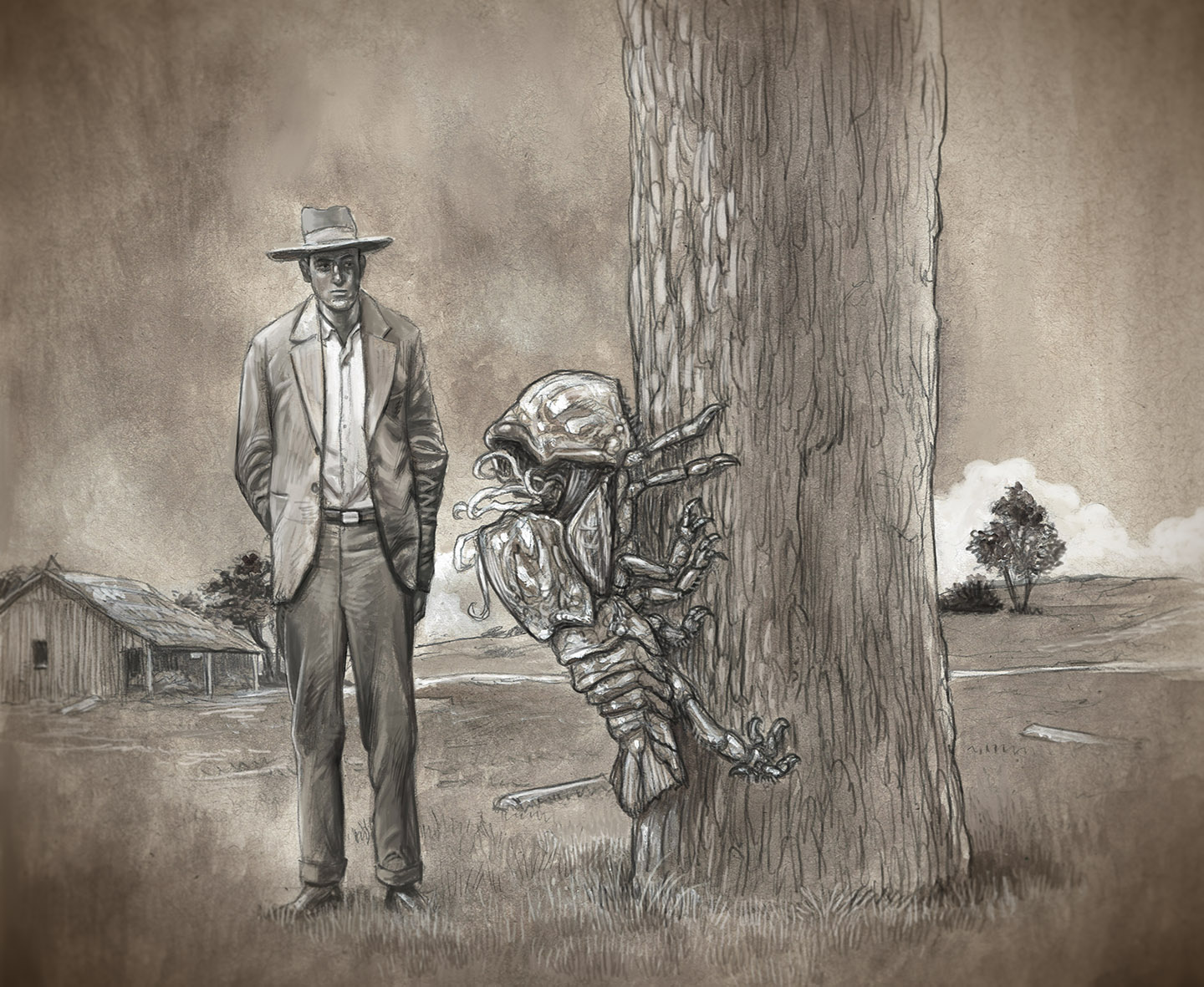
The body of a dead Mi-Go seen in flood waters of the Passumpsic River, Vermont. 
  
 Right off the bat, the whole "fungus thing" trips me up a bit. I suppose it could mean that even their carapaces were made of some sort of fleshy, spongy substance, but for some reason I've always jumped to the conclusion that Lovecraft was referring to their heads and internals- or just their basic molecular structure was fungoid (there are some rather hard and tough fungi out there). I think my design may be a bit too lobster-like, but as I tried to design and re-design my Mi-Go, I kept coming back to it. Well, both fungi and crustaceans have chitin in common. It forms the cell walls of fungi and crustacean exoskeletons.

   The second stumbling block was the whole vaguely humanoid outline. Now, Lovecraft wrote of this in such a way that it gives a bit of leeway. Walking upright on two hind legs with an ovoid head on top may be all he was suggesting. I did know that I wanted to give them larger hind legs, while the rest of the limbs would serve as arms.

Vaguely humanoid? ehhhhhhh....kind of. Vaguely vague. 

   Now, the vaguely humanoid outline comes into play late in the story- like real late, as in the very last sentence- when it is revealed that the strangely stiff and be-robed seated figure of Henry Akeley has been a Mi-Go in disguise, wearing what our narrator,  Albert N. Wilmarth, prays to be just perfect facsimiles of Akeley's face and hands (it's more or less suggested that they are, in fact, Akeley's actual face and hands). So, apparently, all it takes is the mask of a face wrapped around the head and neck with a long yellow scarf, a dressing gown, a pair of human hand gloves, bandages wrapped about the feet, and a comfy chair in a dimly lit room to disguise a Mi-Go as a human being.

"Don’t bother that fresh, shiny cylinder joined to the two testing instruments—the one with my name on it." Okay, H.P. I'm sure that won't come back at some point.

   This complicated things, because all of my early designs were way too bulky to pull off this sort of ruse. I hadn't read the story for about 25 years and had somehow forgotten the bit about them fitting into the shape of a human. I figure the robe in a seated position could have been very bulky with odd shapes here and there and still pass without suspicion in a poorly lit room.

Here is a drawing I did earlier this year, before re-reading the story. There are multiple problems with it. First, the antennae on the head are too long. It lacks hind legs to walk on. Although it does have hands, I wanted more of the Mi-Go's limbs to be practical for an intelligent race capable of hyper advanced surgical procedures.

Early sketch done for this blog, when I was still in the early stages of trying to work out the wings. All of my early sketches (from last week) have this kind of bulky structure. As they go on, they become more streamlined.

The Wings: Wings always give me trouble. The Old Ones' wings gave me a lot of trouble. The wings of the next blog post's subject, the Night Gaunts (or any humanoid with wings apparently sticking out of their scapula), gave me trouble. The wings of the Mi-Go gave me trouble because you have these bat-like fleshy membranous body parts somehow attached to chitinous body parts. Yeah, they're beings from outside the known universe, but Lovecraft mentioned the parallel evolution with our crustaceans, and you can't just have membranous wing attaching to a chitinous carapace. I mean, you could, but it wouldn't look right.


   The first sketches were just trying to figure out how to attach a bat-like wing to an exoskeleton. I was still pretty sure that the final result would definitely not just be a bat wing.


   I decided to try and base my wing design on an insect wing, but one that still looked "bat-like." The wings of larger beetles, like the Hercules Beetle, have this appearance. Toward the bottom of the page, you can see that I started to blend it with a bat wing, complete with a membrane that attached and stretched along the body, as opposed to tapering to a single point connection, like an insect's wing.


    The final design- or, the one I've settled on for now- is combination bat-insect wing that somehow fold up real nice and tight like a real bat wing. Now, real bat wings have a huge wing surface because the membrane basically goes from the bat's shoulder down to its ankles,and then webbing on the tail forms more of a wing surface. Here, the wing surface only goes from the shoulder to about where the hip would be.It wouldn't work at all unless the Mi-Go's body structure was incredibly light -which it may very well be. Well, in the story it does say that the wings were meant to traverse the ether of interstellar space and were not very well suited for flight on Earth. The only one seen flying leapt from the top of a hill, and besides...their very atomic make up- their electron vibrations, it says- are wholly different from ours. There's a little leeway in the physics.


The Limbs: Of this, I am certain: that I really do not know how the limbs of actual crustacea work or fit together and that anyone with a passing expertise on the subject will recoil in disgust at what I've done, BUT...I will again resort to the fact that we're talking about outer beings from outside the known universe, wholly comprised of a different type of matter. I have, however tried my best to adhere to Lovecraft's "parallel evolution" and made these  things try to make as much sense as is possible within my limited knowledge. 


      As you can see in the drawing and quotes from the source material above, dated April 27, 2016, the first thing I tried to tackle was the be-nippered claw of the hind leg, which left the footprints of ambiguous direction. The description says that there was a central pad and then pairs of nippers extending from that. I originally drew 3 pairs of claws, but later brought it down to 2 pairs, for no particular reason. I figure that the claws would lay flat when walking, but all four on each foot could be used like a 4-clawed hand. The multiple claws would become the basis for the other limbs, moving up the torso.


    So, starting with the hindmost pair of legs, we have 4 claws or nippers, as Lovecraft refers to them. The next 3 pairs are the primary hands. I figure that an exceedingly intelligent race that has been on earth for hundreds of millions of years (they came from space and waged war against the Old Ones at one time) capable of  interstellar navigation and travel and miraculous surgery would need something more than claws. These hands have 3 segmented digits, one in the position as a thumb as opposed to being evenly distributed like a tripod. They would have softer, padded surfaces on the palms and undersides of the digits for gripping. The last two pairs of limbs (the topmost) are your basic pincered crab-like limbs.


The Technology: 


   Above is a drawing of, well, the latest in Yuggothian kitchen appliances, apparently. You all know very well that "Akeley" had Wilmarth plug wires from 3 devices into one of the metallic cylinders they use to store the live brains of other beings. One device gave the brain in the cylinder sight, the other a voice, and the third hearing....I think.

    I didn't give the devices described in the story much attention, because I didn't really know where to go with them. It bothers me that such an advanced race, using metals not of this earth, would use dials, wires, plugs, and vacuum tubes. I *suppose* they could have, I dunno, just been efficient by using local hardware they had access to, but....would they really use that technology with beings from other planets during their space travels? This is obviously just a case of Lovecraft not being that keen of a futurist. I mean, with the right two-way brainwave translating software, one smart phone is probably more advanced than all 3 of the devices mentioned in the story.

The Head: For some reason, most artists tend to draw the head looking like a big exposed brain. The story describes the head as "a sort of convoluted ellipsoid, covered with multitudes of very short antennae" and "a lot of pyramided fleshy rings or knots of thick, ropy stuff covered with feelers." Okay, so here we go:


   Now, I don't know the dimensions of the pyramided ring structures or their distribution about the head, but I did want to evoke a fungus-like appearance. It didn't say that the numerous short antennae extended from the tips of the pyramid structures, but it just seemed like the thing to do. I mean, why would antennae be recessed? I took liberties with the mouth area and the modified palps that look like mantis shrimp chelipeds. I haven't drawn the mouth in detail, but I figure that they're similar to crab mouths, although capable of speech. 

    The Mi-Go communicated through 3 methods: telepathy, buzzing noises which could imitate speech in any language, and by changing the colors of its head. I figure that their heads have chromatophores like squid and cuttlefish and can communicate with elaborate color displays (Video of squids communicating through flashing color changes). Most useful in the vacuum of space, although...telepathy would seem to trump any other type of communication, but what do I know?

Molting: As a kind of arthropod, it seems likely that the Mi-Go would have to shed their skin to grow. No mention is ever made of this in any of the stories, so this is just creative speculation. Now, again, they're outer world beings with a fungoid structure, so anything goes, but I like to think that they go through many instars before their final molt, when they finally grow their wings.

Molting Mi-Go

   Above, we see a Mi-Go undergoing its final molt, emerging from in between the first and second segments of the cephalothorax carapace, similar to how a lobster molts. Up to this point, the wings were underdeveloped wing buds, but upon shedding its skin, fluid is pumped into these buds and they grow into full wings.


   Okay, the above is something no one would ever see, but not because the Mi-Go are a secretive species on our plant, but because the exuvia, the shed skin, would disintegrate hours later just as the dead bodies of the Mi-Go do. Being not of our part of the universe, their matter breaks down soon after death. Also, while I made a weak attempt to make it look like a vintage photo, the matter of which Mi-Go are made cannot be photographed (at least by cameras in 1928, when the story takes place). I was just messing around with a silly idea, since I had such a childhood fascination with cicadas.

Himilayan Mi-Go, aka Yeti

Abominable Snowmen and Other Species: Henry Akeley tells Wilmarth that the Vermont species of Mi-Go are one of the few that still have wings. The word Mi-Go comes from the Tibetan Migou- "wild man"- another name for the Yeti or Abominable Snowmen. Supposedly the legends of the Yeti or Migou come from the sightings of the Himalayan species of Mi-Go. Having been on Earth for hundreds of millions of years, they've had plenty of time to evolve into separate species or, I suppose, to surgically or genetically alter themselves to better suit their environments.

   I originally drew the Himalayan Mi-Go covered in long wispy fur, being inspired by the Yeti crab (Kiwa hirsuta) until I realized that 1) the Mi-Go are perfectly fine traversing the cold vastness of space, and 2) that the Yeti crab's fur isn't used for warmth, but possibly for chemosythesis, using the filamentous bacteria to detoxify the water around the deep sea hydrothermal vents where it lives.Still, I wanted there to be some sort of white fur. Enough to possibly have evoked the legends of the Yeti. I also wanted them to be wingless and a bit sturdier; built less lobster-like and more like a coconut crab (Birgus latro). 

***************

    Well, that's all I have for now, I hope to have another post next week. Bye! Follow me on Instagram: https://www.instagram.com/kurt_komoda/


Mi-Go Tessellation from 2022.