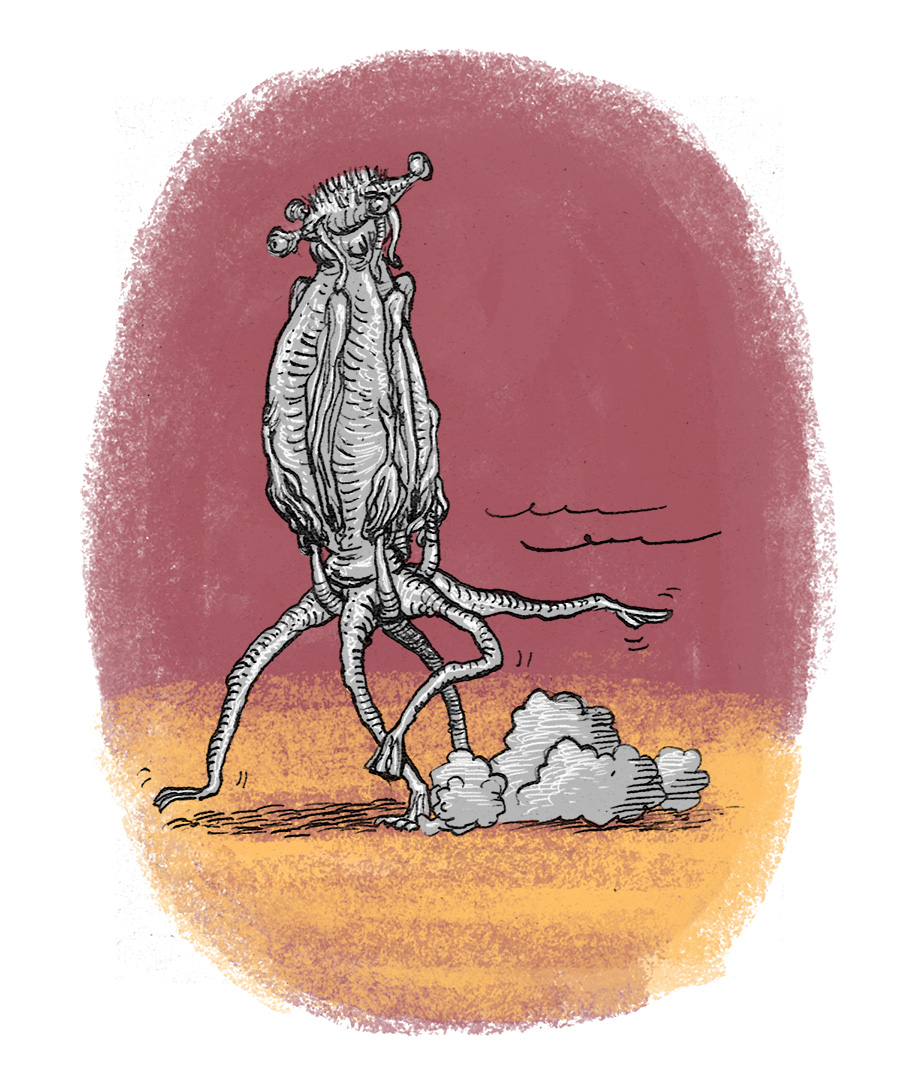
What follows are my attempts to depict H.P. Lovecraft's Mi-Go, the Fungi From Yuggoth (probably Pluto) based on his descriptions in "The Whisperer in the Darkness." I make no claims as to their accuracy, but this was just a fun creative project to do in a week where not a lot of freelance work is coming in. Okay, let's dive in.
The Mi-Go are described as 5' pinkish, vaguely humanoid, crustaceans that were more vegetable than animal, having a fungoid structure- despite the presence of a chlorophyll-like substance. The had several pairs of limbs and great bat-like wings that extending from the middle of their backs.Their heads were a mass of ringed pyramids covered with short antennae, There were a few more descriptions throughout the story, but we'll get into those later.
- Oh, I'm going to be going into spoilers for "The Whisperer in the Darkness, " so if you have not read it- do this now: The Whisperer in the Darkness
 |
| The body of a dead Mi-Go seen in flood waters of the Passumpsic River, Vermont. |
Right off the bat, the whole "fungus thing" trips me up a bit. I suppose it could mean that even their carapaces were made of some sort of fleshy, spongy substance, but for some reason I've always jumped to the conclusion that Lovecraft was referring to their heads and internals- or just their basic molecular structure was fungoid (there are some rather hard and tough fungi out there). I think my design may be a bit too lobster-like, but as I tried to design and re-design my Mi-Go, I kept coming back to it. Well, both fungi and crustaceans have chitin in common. It forms the cell walls of fungi and crustacean exoskeletons.
The second stumbling block was the whole vaguely humanoid outline. Now, Lovecraft wrote of this in such a way that it gives a bit of leeway. Walking upright on two hind legs with an ovoid head on top may be all he was suggesting. I did know that I wanted to give them larger hind legs, while the rest of the limbs would serve as arms.
 |
| Vaguely humanoid? ehhhhhhh....kind of. Vaguely vague. |
Now, the vaguely humanoid outline comes into play late in the story- like real late, as in the very last sentence- when it is revealed that the strangely stiff and be-robed seated figure of Henry Akeley has been a Mi-Go in disguise, wearing what our narrator, Albert N. Wilmarth, prays to be just perfect facsimiles of Akeley's face and hands (it's more or less suggested that they are, in fact, Akeley's actual face and hands). So, apparently, all it takes is the mask of a face wrapped around the head and neck with a long yellow scarf, a dressing gown, a pair of human hand gloves, bandages wrapped about the feet, and a comfy chair in a dimly lit room to disguise a Mi-Go as a human being.
This complicated things, because all of my early designs were way too bulky to pull off this sort of ruse. I hadn't read the story for about 25 years and had somehow forgotten the bit about them fitting into the shape of a human. I figure the robe in a seated position could have been very bulky with odd shapes here and there and still pass without suspicion in a poorly lit room.
 |
| "Don’t bother that fresh, shiny cylinder joined to the two testing instruments—the one with my name on it." Okay, H.P. I'm sure that won't come back at some point. |
This complicated things, because all of my early designs were way too bulky to pull off this sort of ruse. I hadn't read the story for about 25 years and had somehow forgotten the bit about them fitting into the shape of a human. I figure the robe in a seated position could have been very bulky with odd shapes here and there and still pass without suspicion in a poorly lit room.
 |
| Here is a drawing I did earlier this year, before re-reading the story. There are multiple problems with it. First, the antennae on the head are too long. It lacks hind legs to walk on. Although it does have hands, I wanted more of the Mi-Go's limbs to be practical for an intelligent race capable of hyper advanced surgical procedures. |
 |
| Early sketch done for this blog, when I was still in the early stages of trying to work out the wings. All of my early sketches (from last week) have this kind of bulky structure. As they go on, they become more streamlined. |
The Wings: Wings always give me trouble. The Old Ones' wings gave me a lot of trouble. The wings of the next blog post's subject, the Night Gaunts (or any humanoid with wings apparently sticking out of their scapula), gave me trouble. The wings of the Mi-Go gave me trouble because you have these bat-like fleshy membranous body parts somehow attached to chitinous body parts. Yeah, they're beings from outside the known universe, but Lovecraft mentioned the parallel evolution with our crustaceans, and you can't just have membranous wing attaching to a chitinous carapace. I mean, you could, but it wouldn't look right.

The first sketches were just trying to figure out how to attach a bat-like wing to an exoskeleton. I was still pretty sure that the final result would definitely not just be a bat wing.

I decided to try and base my wing design on an insect wing, but one that still looked "bat-like." The wings of larger beetles, like the Hercules Beetle, have this appearance. Toward the bottom of the page, you can see that I started to blend it with a bat wing, complete with a membrane that attached and stretched along the body, as opposed to tapering to a single point connection, like an insect's wing.

The final design- or, the one I've settled on for now- is combination bat-insect wing that somehow fold up real nice and tight like a real bat wing. Now, real bat wings have a huge wing surface because the membrane basically goes from the bat's shoulder down to its ankles,and then webbing on the tail forms more of a wing surface. Here, the wing surface only goes from the shoulder to about where the hip would be.It wouldn't work at all unless the Mi-Go's body structure was incredibly light -which it may very well be. Well, in the story it does say that the wings were meant to traverse the ether of interstellar space and were not very well suited for flight on Earth. The only one seen flying leapt from the top of a hill, and besides...their very atomic make up- their electron vibrations, it says- are wholly different from ours. There's a little leeway in the physics.

The Limbs: Of this, I am certain: that I really do not know how the limbs of actual crustacea work or fit together and that anyone with a passing expertise on the subject will recoil in disgust at what I've done, BUT...I will again resort to the fact that we're talking about outer beings from outside the known universe, wholly comprised of a different type of matter. I have, however tried my best to adhere to Lovecraft's "parallel evolution" and made these things try to make as much sense as is possible within my limited knowledge.

As you can see in the drawing and quotes from the source material above, dated April 27, 2016, the first thing I tried to tackle was the be-nippered claw of the hind leg, which left the footprints of ambiguous direction. The description says that there was a central pad and then pairs of nippers extending from that. I originally drew 3 pairs of claws, but later brought it down to 2 pairs, for no particular reason. I figure that the claws would lay flat when walking, but all four on each foot could be used like a 4-clawed hand. The multiple claws would become the basis for the other limbs, moving up the torso.

So, starting with the hindmost pair of legs, we have 4 claws or nippers, as Lovecraft refers to them. The next 3 pairs are the primary hands. I figure that an exceedingly intelligent race that has been on earth for hundreds of millions of years (they came from space and waged war against the Old Ones at one time) capable of interstellar navigation and travel and miraculous surgery would need something more than claws. These hands have 3 segmented digits, one in the position as a thumb as opposed to being evenly distributed like a tripod. They would have softer, padded surfaces on the palms and undersides of the digits for gripping. The last two pairs of limbs (the topmost) are your basic pincered crab-like limbs.

The Technology:

Above is a drawing of, well, the latest in Yuggothian kitchen appliances, apparently. You all know very well that "Akeley" had Wilmarth plug wires from 3 devices into one of the metallic cylinders they use to store the live brains of other beings. One device gave the brain in the cylinder sight, the other a voice, and the third hearing....I think.
I didn't give the devices described in the story much attention, because I didn't really know where to go with them. It bothers me that such an advanced race, using metals not of this earth, would use dials, wires, plugs, and vacuum tubes. I *suppose* they could have, I dunno, just been efficient by using local hardware they had access to, but....would they really use that technology with beings from other planets during their space travels? This is obviously just a case of Lovecraft not being that keen of a futurist. I mean, with the right two-way brainwave translating software, one smart phone is probably more advanced than all 3 of the devices mentioned in the story.
The Head: For some reason, most artists tend to draw the head looking like a big exposed brain. The story describes the head as "a sort of convoluted ellipsoid, covered with multitudes of very short antennae" and "a lot of pyramided fleshy rings or knots of thick, ropy stuff covered with feelers." Okay, so here we go:

Now, I don't know the dimensions of the pyramided ring structures or their distribution about the head, but I did want to evoke a fungus-like appearance. It didn't say that the numerous short antennae extended from the tips of the pyramid structures, but it just seemed like the thing to do. I mean, why would antennae be recessed? I took liberties with the mouth area and the modified palps that look like mantis shrimp chelipeds. I haven't drawn the mouth in detail, but I figure that they're similar to crab mouths, although capable of speech.
The Mi-Go communicated through 3 methods: telepathy, buzzing noises which could imitate speech in any language, and by changing the colors of its head. I figure that their heads have chromatophores like squid and cuttlefish and can communicate with elaborate color displays (Video of squids communicating through flashing color changes). Most useful in the vacuum of space, although...telepathy would seem to trump any other type of communication, but what do I know?
Molting: As a kind of arthropod, it seems likely that the Mi-Go would have to shed their skin to grow. No mention is ever made of this in any of the stories, so this is just creative speculation. Now, again, they're outer world beings with a fungoid structure, so anything goes, but I like to think that they go through many instars before their final molt, when they finally grow their wings.
 |
| Molting Mi-Go |
Above, we see a Mi-Go undergoing its final molt, emerging from in between the first and second segments of the cephalothorax carapace, similar to how a lobster molts. Up to this point, the wings were underdeveloped wing buds, but upon shedding its skin, fluid is pumped into these buds and they grow into full wings.
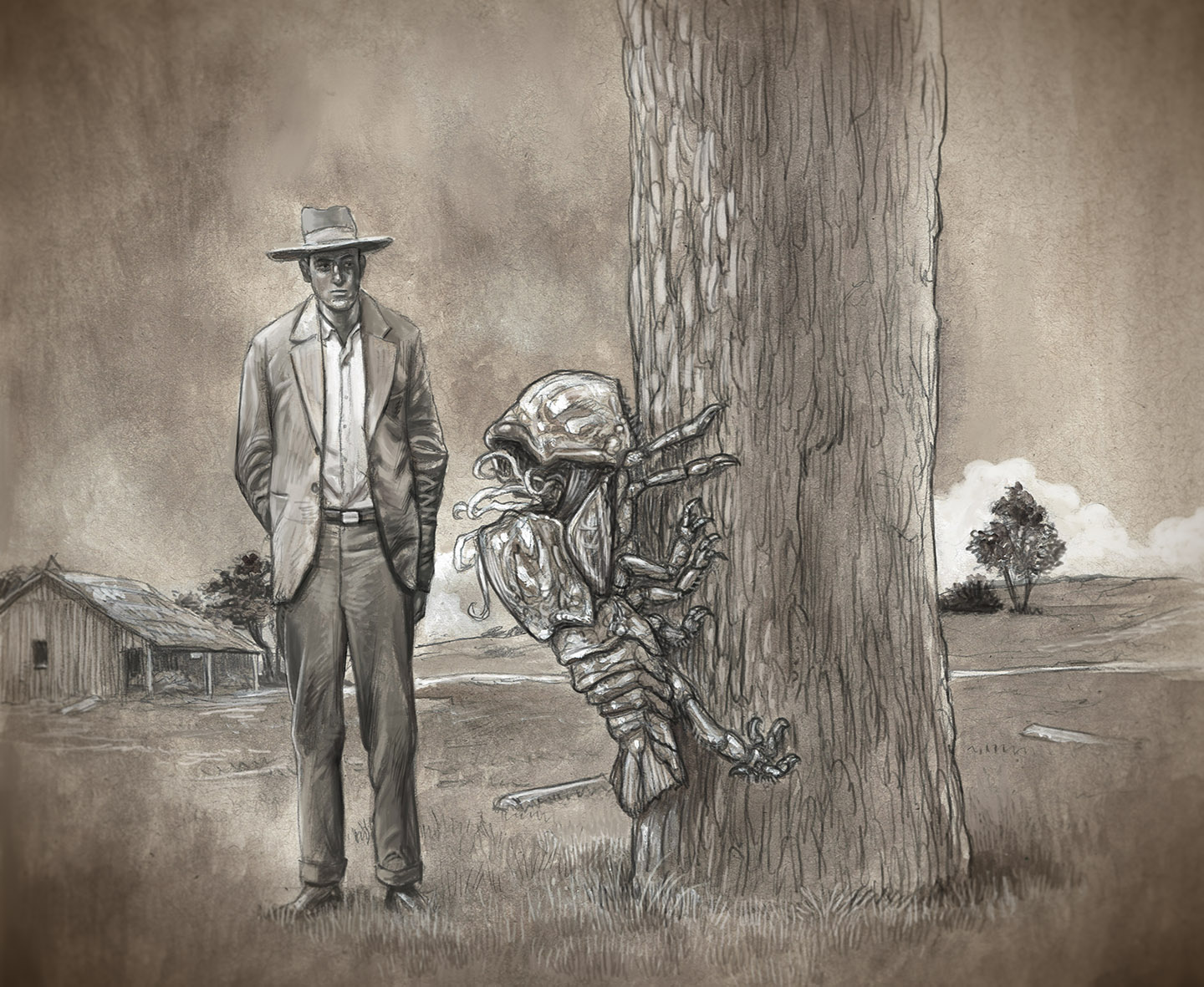
Okay, the above is something no one would ever see, but not because the Mi-Go are a secretive species on our plant, but because the exuvia, the shed skin, would disintegrate hours later just as the dead bodies of the Mi-Go do. Being not of our part of the universe, their matter breaks down soon after death. Also, while I made a weak attempt to make it look like a vintage photo, the matter of which Mi-Go are made cannot be photographed (at least by cameras in 1928, when the story takes place). I was just messing around with a silly idea, since I had such a childhood fascination with cicadas.
 |
| Himilayan Mi-Go, aka Yeti |
Abominable Snowmen and Other Species: Henry Akeley tells Wilmarth that the Vermont species of Mi-Go are one of the few that still have wings. The word Mi-Go comes from the Tibetan Migou- "wild man"- another name for the Yeti or Abominable Snowmen. Supposedly the legends of the Yeti or Migou come from the sightings of the Himalayan species of Mi-Go. Having been on Earth for hundreds of millions of years, they've had plenty of time to evolve into separate species or, I suppose, to surgically or genetically alter themselves to better suit their environments.
I originally drew the Himalayan Mi-Go covered in long wispy fur, being inspired by the Yeti crab (Kiwa hirsuta) until I realized that 1) the Mi-Go are perfectly fine traversing the cold vastness of space, and 2) that the Yeti crab's fur isn't used for warmth, but possibly for chemosythesis, using the filamentous bacteria to detoxify the water around the deep sea hydrothermal vents where it lives.Still, I wanted there to be some sort of white fur. Enough to possibly have evoked the legends of the Yeti. I also wanted them to be wingless and a bit sturdier; built less lobster-like and more like a coconut crab (Birgus latro).
***************
Well, that's all I have for now, I hope to have another post next week. Bye! Follow me on Instagram: https://www.instagram.com/kurt_komoda/

 |
| Mi-Go Tessellation from 2022. |